
GOATS ON THE ROOF
OF THE SMOKY MOUNTAINS
865.366.7139
OF THE SMOKY MOUNTAINS
865.366.7139

Posted by Phil Rodgers in Goats on the Roof
When you see a goat standing high above the ground, your first question might be simple: How did it get up there?
Goats are surprisingly talented climbers. They are curious, intelligent and naturally comfortable exploring places that might look difficult to reach. Those abilities help explain why seeing goats high above the ground seems unusual to us but perfectly reasonable to a goat.
For families visiting the Smoky Mountains, learning a little about goats can make seeing the famous rooftop residents at Goats on the Roof of the Smokies even more entertaining.
Here are some fun goat facts kids and adults can enjoy together.
Many goats are remarkably comfortable on steep and uneven terrain. Their ancestors adapted to environments where being able to move across rocky ground helped them find food and stay safe.
That natural ability is still easy to see today. Give a goat something interesting to climb, and there is a good chance it will investigate.
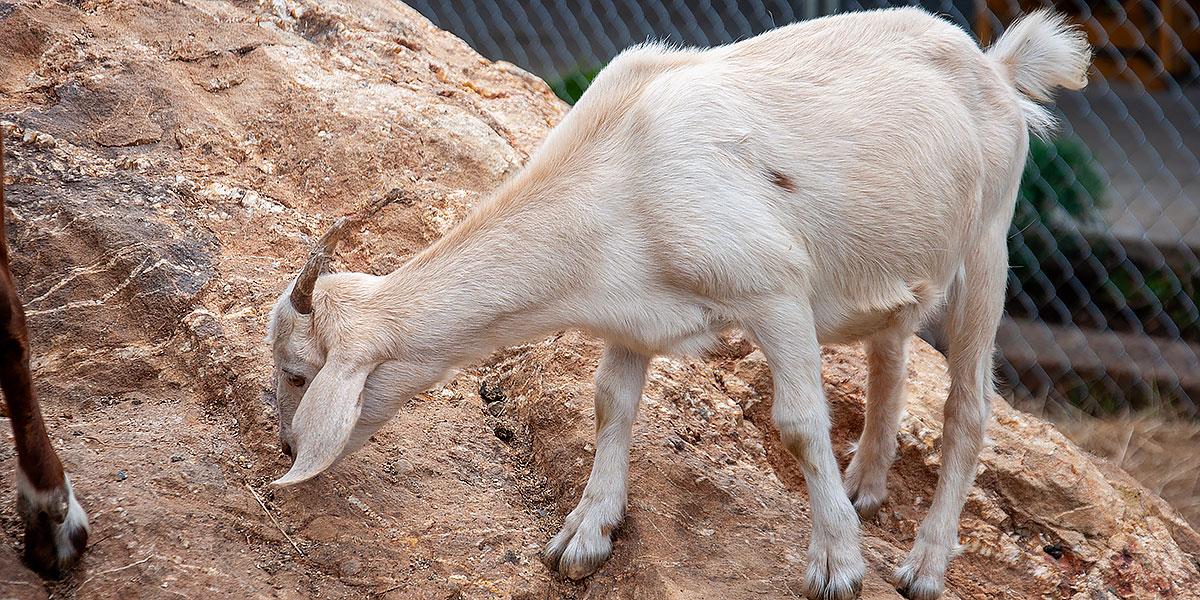
Goat hooves are divided into two sections. This structure helps goats adjust their footing on uneven surfaces. The bottoms of their feet also help provide traction.
Together, these features give goats an impressive ability to balance and move across terrain that would be difficult for many other animals.
Kids watching a goat move confidently around an elevated area are seeing some impressive natural engineering in action.
They may explore unfamiliar objects, climb onto new surfaces or spend time examining something that has caught their attention.
This curiosity is one reason goats can be so entertaining to watch. They are active animals with individual personalities, and you never know exactly what they will decide to investigate next.
Goats have horizontal, rectangular-shaped pupils rather than the round pupils humans have. Their eye structure gives them a very wide field of vision.
That broad view helps them stay aware of what is happening around them, an important ability for animals that historically needed to watch for predators while grazing.
It is one of the most distinctive features you may notice when seeing a goat up close.
The familiar sound a goat makes is commonly called a bleat. Goats can use vocalizations to communicate with other members of their group.
They also communicate through body position and behavior.
If you spend a little time watching several goats together, you may begin noticing that they interact much more than you initially expected.
A young goat is called a kid.
An adult female goat is generally called a doe or nanny, while an adult male is called a buck or billy.
That means when someone talks about a group of kids around goats, you may need to ask which kind they mean.
Within a group, individual animals may develop their own relationships and social positions. They interact, play, rest and explore their surroundings together.
This social behavior is another reason watching goats can be interesting. Instead of simply standing in one place, they often seem busy interacting with their surroundings and one another.
That's not really how goats eat.
Goats are browsers, which means they naturally investigate a variety of plants and vegetation. They often use their mouths to examine objects, which may make it look like they are trying to eat everything they encounter.
Being curious about something and actually considering it food are two different things.
They can climb, jump and carefully position their feet while navigating obstacles. Their combination of balance, strong legs and specialized hooves makes them much more agile than their appearance might suggest.
This is especially noticeable when you see goats comfortably exploring elevated spaces.
Some may be especially curious. Others may be more relaxed. One might be interested in what's happening nearby while another seems perfectly content to find a comfortable spot and watch everything from a distance.
Recognizing those individual differences makes watching them even more fun.
Seeing an animal in person encourages questions.
Why are its eyes shaped that way? How can it climb so well? What does it eat? Why does it make that sound?
Those simple questions can introduce children to animal behavior, anatomy, habitats and adaptation.
A memorable encounter often makes those lessons easier to remember than reading the same facts in a textbook.
Children can compare what they notice, and parents may discover that they start paying closer attention too.
You can see mountain scenery, explore Great Smoky Mountains National Park, visit Pigeon Forge and Gatlinburg, enjoy family attractions and still have time for unusual stops you probably won't encounter back home.
If you're putting together a larger trip, our Smoky Mountain Vacation Planning Guide can help you organize your days without overloading your schedule.
Families interested in exploring the mountains themselves can also use our Great Smoky Mountains National Park Guide to find scenic drives, short walks and other ways to experience the park.
Goats have specialized hooves, impressive balance, strong climbing instincts and plenty of curiosity. Put those traits together and elevated spaces become interesting places to explore.
So the next time your family sees a goat confidently standing somewhere that seems impossible, take another look at its feet, eyes and movements.
You may discover that there is a lot more going on than you thought.
Other blog categories:
Family Activities Goats on the Roof Nearby Attractions Pigeon Forge Places To Eat Seasonal in the Smokies Smoky Mountains Things to Do Travel Tips Wears Valley
Home
Goat Coaster
Gift Shop
Parkway Store
Sweet Shop
Miniature Golf
Gem Mining
Goat Stories
Goat Videos
Goat Photos
Blog
Directions
FAQ
Preferred Partners
Sitemap
1341 Wears Valley Road • Pigeon Forge, TN 37863 • 865.366.7139

Copyright © 2026 Goats On The Roof Of The Smoky Mountains. All Rights Reserved. Blue